
Download the 2026 Ohio Brownfields Conference Panel Presentations and Materials
2026 Ohio Brownfields Conference Panel Sessions
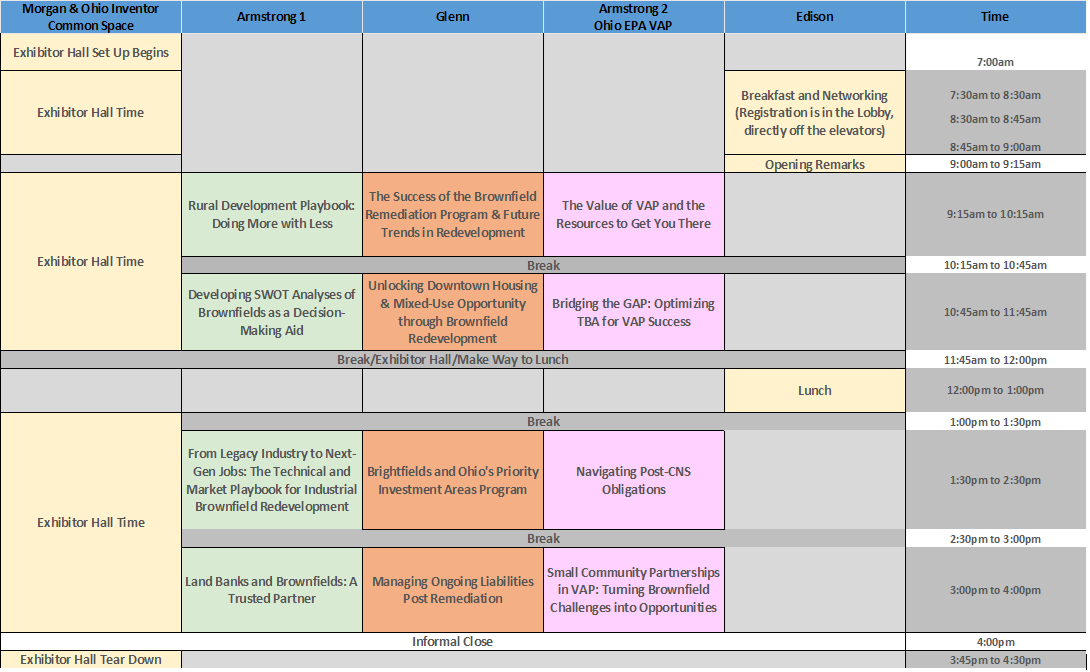
The 2026 Ohio Brownfields Conference schedule is below. Full panel details, including a panel description and panelists, follows. Panels are subject to change as the conference approaches.
Seeking Continuing Learning Credits? You’re in Luck!
Each Ohio EPA VAP panel is eligible for VAP CP PDHU Credits.
Attendance at the conference is eligible for six OhioCED credits through the Ohio Economic Development Association.
Each panel is eligible for AICP Credits through APA Ohio.
Attendance at the conference is eligible for up to four CLE Credits through the Ohio Supreme Court.
-
Brownfields in rural areas have all the same environmental challenges as urban brownfields, but they can also face the additional headwinds by being in low-density areas with fewer financial resources and potential users. On the other hand, rural Ohio is desperate for spec buildings that can attract new employers and quality housing that will retain and attract employees, and brownfields offer workable solutions for both.
This session will provide a practical roadmap for Ohio’s rural and smaller communities, including how to plan, prepare, and execute through coalition building, grant administration, and leveraging technical assistance to move projects from assessment to ribbon-cutting. This panel will note different sources of funding, financing, and technical assistance available to Appalachia and rural Ohio.
Moderator: Roxanne Anderson, TAB Regional Director for EPA Region 5, KSU TAB
Speakers:
Dave Walker, Section Director, Assessment & Remediation Section, Burgess & Niple
Shannon Wells, Director of Economic Development, Morgan County Economic Development
-
Five years into the Ohio Brownfield Remediation Grant Program, Ohio's communities are experiencing the benefits of transformational projects under construction and recently completed across the State. Hear from developers and consultants about remediation projects completed and underway across the State, including challenges and pitfalls tied to the remediation strategies. Panelists will share lessons learned in this era of brownfield remediation and what they expect for Ohio in the future as markets shift and trends emerge in the brownfield remediation realm.
Speakers:
Ken Kalynchuk, Director and Principal, Project Management Consultants (PMC)
Aaron Pechota, Executive Vice President of Development, NRP Group
Demetrius Thomas, Executive Director, Ohio Chamber of Commerce Research Foundation
-
The Voluntary Action Program (VAP) may seem complex, but it’s the only route to a true liability release through a Covenant Not to Sue (CNS). This session goes beyond the basics to show you exactly where to find help. We’ll walk through the Technical Guidance Compendiums (TGCs) and show you how to prepare for a No Further Action (NFA) letter.
Moderator: Madison Graham, Environmental Specialist 2, Ohio EPA
Speakers:
Corin Fogle, Supervisor—VAP, Enforcement, Remedial, & Brownfield Section, Ohio EPA
Sarah Ewing, Senior Scientist, Verdantas
-
Completing a strengths, weaknesses, opportunities, and threats (SWOT) analysis for underutilized properties within a community, county, or region can be an important part of your economic development strategy. These analyses are tailored, but typically focus on site readiness, development challenges, transportation assets, available workforce, and strategic redevelopment pathways. They can identify heavy constraints on certain properties, such as environmental conditions, utility gaps, and redevelopment complexity while offering targeted interventions through funding, site assembly, remediation, and infrastructure updates. Attend this session to learn more about SWOT analyses and how such a study could provide the roadmap for your brownfield and economic development programs.
Moderator: Pam Nixon, Senior Project Manager, Verdantas
Speakers:
Damon Taseff, Chief Executive Officer and Principal, Allegro
Christine Nelson, Vice President, Project Management and Site Strategies, Team NEO
-
Ohio’s downtowns and neighborhoods are full of underutilized sites—and local leaders are turning brownfields into catalytic, community-serving places. This panel explores how brownfield assessment, cleanup, and redevelopment can expand housing at a range of price points while also delivering mixed-use projects that support small businesses, jobs, and vibrant public spaces. Panelists will share case studies that move from concept to construction, walking through the full redevelopment journey: aligning land use and design with market realities, coordinating community engagement, assembling the right partners across sectors, and sustaining long-term stewardship. The conversation will also highlight practical tools and financing strategies—especially how to stack local, state, and federal resources and leverage complementary housing programs—to keep projects moving and maximize impact in walkable downtowns and existing neighborhoods.
Moderator: Betsy Goldstein, Founder and CEO, Betsy Goldstein Consulting
Speakers:
Carolyn Thurman, Founder and Principal, Civic Uplift, LLC
Sarah Arellano Higgins, Executive Director, Columbus Redevelopment Corporation
Brian Higgins, Associate Director, Columbus Redevelopment Corporation
-
Learn how Targeted Brownfield Assessments (TBAs) can jumpstart Voluntary Action Program (VAP) projects by identifying potential liabilities early and shaping remediation strategies. This session covers practical steps for integrating TBA data into VAP planning, timing for Phase II requests, and lessons from the Euclid Woodlawn case study—a $500,000 EPA Brownfield Cleanup Grant project nearing completion in Cleveland, Ohio.
Moderator: Sarah Tebbe, Environmental Specialist 2, Ohio EPA
Speakers:
Vince Adamus, Environmental Project Manager, Cuyahoga County Land Bank
Halle Miller, Associate Director—Assessment, Remediation & Revitalization, Partners Environmental
Shelby Powell, Brownfield Coordinator, Ohio EPA
Wade Meese, Vice President, Innovative Environmental Technologies
-
Industrial brownfields can be the fastest path to job creation—but only when cleanup strategy, infrastructure planning, and market positioning are built together. This technical panel walks through the industrial redevelopment playbook for large, complex sites. Panelists will also share how teams reposition and market industrial properties, align remediation and demolition with end-user requirements, and stack state, local, and federal incentives to attract advanced manufacturing and maker-space investment.
Moderator: Diana Rife, Managing Director, Sites, JobsOhio
Speakers:
Matt Abbott, President and CEO, OhioSE
Dave Williams, Managing Director of Development Services, Bricker Graydon Wyatt LLP
Matt Davis, Vice President, Real Estate, RGP Northwest
-
Across the United States, over 624 brownfield and other previously disturbed sites have been reused to host renewable energy projects. “Brightfields” (renewable energy projects on brownfields) can breathe new life into otherwise neglected and abandoned sites, reuse existing infrastructure, generate local revenue, and support new jobs. In 2025, Ohio passed a new law creating "Priority Investment Areas” to encourage new energy infrastructure investment on brownfields and former mine sites, increase grid reliability, and reduce pressure to use agricultural land for renewable energy projects. Priority Investment Areas are driven by local decision-making, and once designated, these sites become eligible for state incentives. Through this interactive panel session, participants will learn more about the fundamentals of brightfields, Ohio's Priority Investment Areas program, and the early stages of the program’s implementation in Ohio so communities and site owners can factor this into their site reuse planning.
Moderator: Matthew Popkin, Manger, Brightfields Accelerator RMI
Speakers:
Dana Vingris, Director of Grants and Development, SOPEC
Mollie Fitzgerald, Executive Director, Athens County Economic Development Council
-
What happens after a property is issued a Covenant Not to Sue? Can I redevelop or change land uses? Join staff from Ohio EPA and Civil & Environmental Consultants as they dive into the post-CNS world. This session will cover successful practices for audits and remedy revisions, long-term site management, institutional controls and a remedy revision case study. In addition to hearing perspectives from the Ohio EPA and a Certified Professional, this session will cover how volunteers can stay compliant post-CNS issuance.
Moderator: Kate Rector, Environmental Specialist 2, Ohio EPA
Speakers:
Brent Smith, Principal, Civil & Environmental Consultants (CEC)
Mary Mahaffee, Environmental Specialist 2, Ohio EPA
Sarah Lynn, Attorney, Division of Environmental Response and Revitalization, Ohio EPA, Ohio EPA
-
Join this panel to learn directly from Land Bank leaders on successful brownfield remediation and redevelopment projects, and the unique role they play in brownfield redevelopment. Over the past few years, Land Banks have been heavily involved in the state’s Brownfield Remediation Program. Hear from Land Banks on their long‑term strategies, technical support they need (and sometimes don’t need!), and what successful partnerships look like with Land Banks, community leaders, and consultants.
Speakers:
Heather Wendel, Program Manager, Montgomery County Land Bank
Gillian Costatino, Property Intake and Environmental Programs Coordinator, Trumbull Neighborhood Partnership
Andy Roberts, Executive Director, Muskingum County Land Bank
Jordan Torrance, Executive Director, Ashtabula County Land Bank (Panel Moderator)
-
Remediation construction crews have left. The property was closed in accordance with the appropriate regulatory program. But for many projects, work remains. Come to this session to hear facts and perspectives from a developer, attorney, and environmental consultant about details of long-term operations & maintenance (O&M) and monitoring obligations. Leave this session with a better understanding of what triggers the need for O&M and monitoring, potential post-remediation activities that could be required, upfront considerations during remedial planning that could minimize long-term obligations, Risk Mitigation Plan implementation and reporting, transferable obligations when the property is sold such as building occupancy limitations and land use restrictions, and the duration and potential costs of this often-unanticipated work.
Moderator: Lindsay Crow, Real Estate Market Leader, Verdantas
Speakers:
Matt Montecalvo, Civil and Environmental Manager, DiGeronimo Companies
Christopher Jones, Senior Counsel, Calfee
-
Robust state and federal brownfield funding opportunities have become a game changer for cleanup and redevelopment efforts across Ohio. This session will explore how small communities in Belmont County have leveraged partnerships and resources to transform brownfield liabilities into redevelopment opportunities. Learn how collaboration between municipalities, developers, and state agencies—through the Voluntary Action Program (VAP) has driven success. We’ll highlight strategies such as Targeted Brownfield Assessments (TBA), market studies, brownfield inventories, and vision planning lead to site assessment and cleanup. We’ll explore State and Federal technical and financial support. Attendees will gain insight into funding approaches, partnership models, and real-world redevelopment outcomes that demonstrate how perseverance and collaboration can achieve brownfield dreams.
Moderator: Richard Murray, Environmental Specialist 2, Ohio EPA
Speakers:
Crystal Lorimor, Executive Director, Belmont County CIC
Matthew Wagner, Program Manager, Tetra Tech
Dan Tjoelker, Lead Brownfield Coordinator, Ohio EPA